Opossum
Opossum Facts
| Size | 12-20 inches (32-50 cm) (body length) |
| Speed | Up to 15.5 mph (25 km/h) |
| Weight | 4-6 pounds (1.9-2.8 kg) |
| Lifespan | 1-2 years |
| Food | Insects, small vertebrates, carrion |
| Predators | Domestic dogs, coyotes, foxes, lynxes, birds of prey |
| Distribution | North America, South America |
| Habitat | Rainforest, swamps, scrubland, forest |
| Order | Didelphimorphia |
| Family | Didelphidae |
| Scientific name | Didelphis |
| Characteristics | Large marsupial with a long tail, resembles a rat |
Main Characteristics
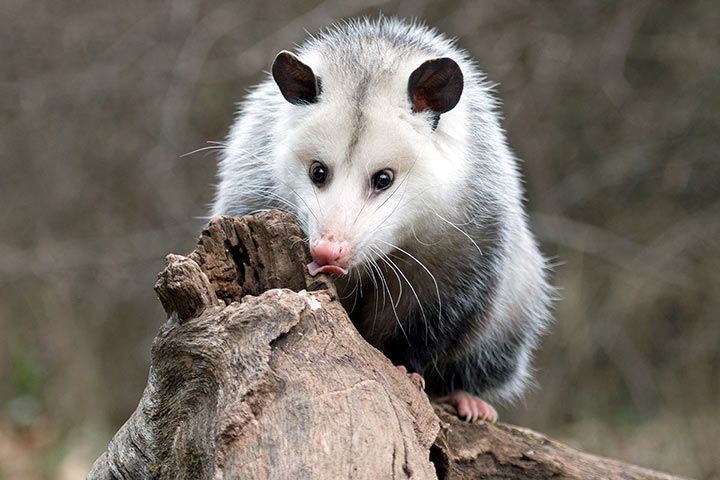
Opossums are large, nocturnal marsupials found in North and South America. They have grayish-brown fur, a white face, and a long, hairless 'rat' tail. They are famous for playing dead when they feel threatened. The best-known species is the Virgina opossum, which is the only species that livs north of Mexico. One of the most famous individuals was a female named Heidi at the Leipzig Zoo.
Records
Opossums are the first mammals in which biofluorescence was discovered. This occurred in 1983. They glow pink when exposed to UV light. Additionally, the opossum is the marsupial that lives the farthest north, even being found in Canada. There's another record: the opossum has the shortest gestation period of any mammal. While elephants carry their young for 22 months, opossum babies are born after just 12-13 days.
Species
Opossums are frequently mistaken for rodents. However, they are marsupials – just like kangaroos and koalas. There are six species: the North American or Virginia opossum, the Southern or black-eared opossum, the Guianan white-eared opossum, the common white-eared opossum, the big-eared opossum, and the Andean white-eared opossum.
Opossum or Possum?
There is often confusion about the difference between an opossum and a possum. Here's the thing: In Australia and New Zealand, there are also marsupials referred to as possums to help differentiate them. However, in America, these animals are generally called "possum". Perhaps it's also a bit of laziness to avoid saying the whole word. So, how do these animals differ? Aside from living on different continents: Most possums do not have a bright face, but rather a gray one. Additionally, most of them are noticeably smaller.
Distribution and Habitat
Distribution
Opossums are found in the wild only in America. The Virginia opossum is the most widespread and well-known species. It is the only opossum and also the only marsupial in North America, ranging from Canada in the north to Costa Rica in the south. Other species are located in South America. Their close relatives, the possums, are found exclusively in Australia and New Zealand. There are no opossums living in the wild in Germany.
Habitat
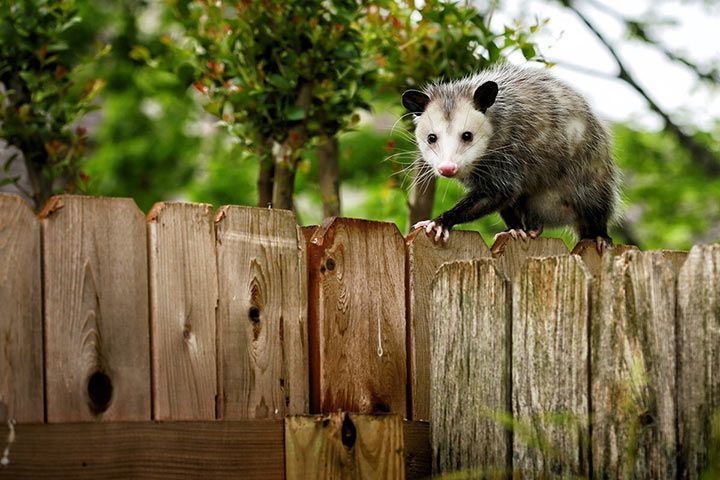
Their habitat includes moist forests, swamps, and areas with plenty of bushes. They also thrive near humans, as there is often a lot of food available. As a result, they may nest in sheds, barns, or under houses.
Way of Life
Opossums are nocturnal creatures that sleep during the day. To stay safe from predators, they hide in hollow tree trunks, abandoned rodent burrows, or other sheltered spots. They also go into sheds and attics. They tend to be solitary, but occasionally they share caves with other members of their species.
Anatomy and Appearance
Physique
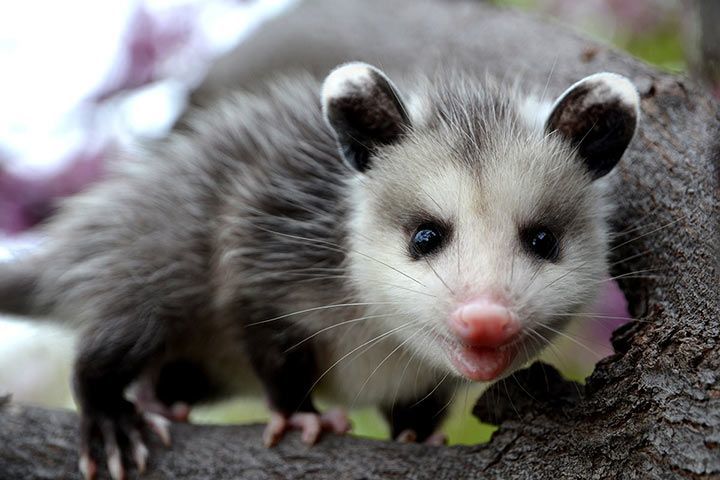
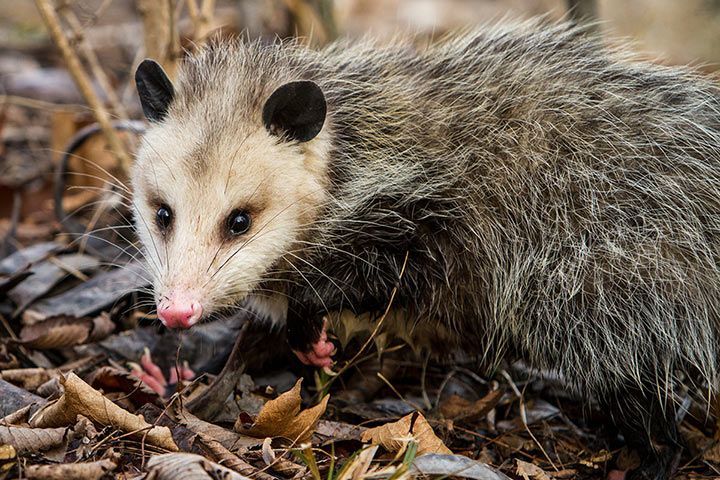
Opossums have a gray coat, a white face, a long pointed snout, dark eyes, hairless ears, and a long hairless tail.
Size and Weight
Opossums can grow as large as house cats. Their body length ranges from 32 to 50 cm, and they weigh between 1.9 to 2.8 kg.
Teeth
The North American opossum has 52 teeth, holding the record for the most teeth among mammals in North America. That should make the dentist happy (just a little joke)! By the way, humans typically have only 32 teeth.
Tail
The bare gray tail is about one-third to half the length of their body. It is a prehensile tail, allowing the animals to hang upside down from branches.
Thumbs
Opossums have opposable thumbs on their hind paws, meaning they can position their thumbs opposite to their fingers. Just like we humans do with our thumbs and index fingers to grasp things.
Diet
Opossums are omnivores. They particularly enjoy eating insects, especially grasshoppers, crickets, and beetles. However, they also feed on small vertebrates such as rodents, reptiles, birds, fish, and amphibians. Additionally, they consume carrion, plants, fruits, and grains. They often rummage through trash cans, causing frustration for local residents.
Do Opossums Eat Ticks?
Opossums are often referred to as "tick-eating machines". They are said to eliminate up to 5,000 ticks in a single night, which makes them quite popular among us humans. However, this belief was based on a test conducted in captivity. Ticks were placed on the fur of the opossums, and they quickly devoured them. It's no surprise, as they tend to eat just about anything that crosses their path. Yet, no ticks have been found in the stomachs of wild opossums so far.
Behavior
Why Do opossums Play Dead?
Opossums can't run very fast. So what do they do when a predator approaches? First, they hiss and growl to scare off their attacker. If that doesn't work, they curl up, stick out their tongue, drool foamy saliva, and lie still with their eyes open. Additionally, they emit a foul odor from their rear and release feces. Predators believe the opossum is dead, give up the chase, and look for other prey. This deception can last for up to six hours. It's not a conscious action they can control; it happens involuntarily (like fainting).
Do Opossums Hang by Their Tails to Sleep?
In animated films and series, opossums are often depicted hanging by their tails from a branch to rest and sleep. However, in reality, only the young ones do this. Adult opossums do not have strong enough muscles in their tails to support their weight for long periods. They do use their tails for climbing, to hold on and support themselves. When they hang by their tails, it is only for a very short time, for instance, to free their hands to reach for food.
Are Opossums Dangerous?
Opossums are not considered dangerous or aggressive. They tend to be shy and peaceful creatures. However, they can transmit rabies, which poses a significant risk to humans and our pets. That said, opossums very rarely carry rabies. There are other wild animals that are much more likely to have it. Interestingly, they are immune to the rabies virus.
Sounds
Opossums make a variety of sounds. They communicate with their young using clicks, smacks, and whistles. When threatened, they hiss, growl, and even burp.
Movement
Unlike dogs or cats, which place their paws alternately, opossums move both feet on one side at the same time, then both on the other side - similar to a camel. Opossums are quite clumsy and slow in their movements. Their gait resembles a bit of a limp.
Senses and Abilities
Senses
Opossums have a remarkable sense of smell. Their eyesight isn't particularly sharp, but they are not blind either. Their eyes are primarily adapted for seeing at night.
Climbing
Opossums are excellent climbers, yet they spend most of their time on the ground.
Swimming
Opossums are capable swimmers, but they prefer to stay on the ground.
Immune to Rabies
Opossums can transmit rabies, but they cannot become infected with the disease. They are immune to rabies. They possess an incredibly strong immune system that fights off many viruses and bacteria. Additionally, their body temperature is quite low, making it difficult for pathogens to thrive.
Opossums and Wildlife
Opossums are known to kill and eat chickens, their chicks, and eggs, as well as ducks. They also commonly prey on rats and mice. They are even unafraid of snakes, sometimes hunting down venomous ones.
Opossums and Pets
Opossums do not kill cats. Being smaller, they often feel intimidated by cats and prefer to play dead when in doubt. Generally, cats do not attack opossums; they tend to ignore them instead. However, caution is advised: opossums can pose a risk to horses if they drink water contaminated with opossum feces. This feces may contain a parasite that can cause a serious brain inflammation in horses.
Life Expectancy
In the wild, opossums can live for 1-2 years.
Enemies and Threats
Natural Enemies
Opossums face numerous predators. The most significant ones include free-roaming domestic dogs, coyotes, foxes, lynxes, raccoons, large hawks, and owls.
Human Impact
Hunting
In America, Virginia opossums are often hunted because they occasionally prey on chickens. Additionally, they are killed for rummaging through trash in search of food, which creates a mess.
Road Traffic
In the USA, approximately 19 million opossums die on the roads each year. Why is that? They often feed on dead animals that have been killed in car accidents and left on the road. While they are eating, they themselves get run over. This figure is based on an estimate, as not every dead animal is found and examined.
In New Zealand, a Pest – Due to the Fur Industry
In New Zealand, the possum, known as the brushtail possum, is considered a pest. It is not a native species but was introduced from Australia and has proliferated significantly due to the absence of natural predators. Why was it brought to New Zealand in the first place? To make clothing and other items from their fur. The fur industry has also contributed to the displacement of many native species by the possum.
Opossum Heidi
Heidi was the name of a world-famous opossum that lived in the Leipzig Zoo. She became well-known for her prominent bulging eyes and her strong squint. Her appearance brought smiles to many faces. One possible reason for her look was her significant overweight. As a result, she was put on a healthy, low-calorie diet rich in vegetables. Heidi passed away in September 2011 due to old age – she was 3 years old.
Opossum as a Pet
Opossums are wild animals and therefore not suitable as pets. It is quite challenging to keep them in a way that meets their needs, so they are better off living in the wild. In Germany, it is not illegal, but it is not recommended. In most states in the USA, it is illegal to keep them. good pets
Importance for the Ecosystem
Opossums may not look attractive, as they resemble large rats. However, they play a very important role in maintaining balance in nature. Since they eat just about anything they can catch, they are excellent pest controllers. Even carrion. This helps prevent the spread of bacteria and viruses. Interestingly, they even pollinate the flowers of a sandwood-like plant called Scybalium fungiforme!
Evolution
Opossums have been trudging around on Earth for 70-80 million years, making them some of the oldest "living fossils".
Reproduction
Mating Season
Opossums are generally solitary creatures. Therefore, they only come together during the mating season, which starts in the middle of winter and lasts until the middle of summer. Before a female opossum gives birth to her young, she thoroughly cleans her pouch for her offspring.
Names
A female opossum is called a Jill, while a male is referred to as a Jack. A baby opossum is known as a Joey.
Gestation Period
The gestation period is one of the shortest among mammals, lasting only 12-14 days. The babies are born blind, hairless, measuring just 1-2 cm in length, and weighing between 0.13 to 0.20 grams.
Litter Size
Opossums can have offspring multiple times a year. A single litter can contain up to 20 babies. However, they only have 13 nipples. Only the newborns that manage to reach a nipple to drink their mother's milk have a chance of survival.
Raising Young
After two to three months, the young opossums leave the pouch for the first time and crawl onto their mother's back. She carries them everywhere and takes them along while foraging for food. By around nine months, they become independent and start to go their own ways.
Fun Facts
In German
The opossum is called the same in German as it is in English: opossum.
In Spanish
In Spanish, the opossum is referred to as "Zarigüeya". Quite a tongue twister! It is pronounced: sa-ri-gweh-ya.
Ice Age
In the animated film Ice Age 2, there are two opossums: the brothers Crash and Eddie.
The Opossum Is Related To:
- Possums
Animals in the Same Biome:
Sources:
- „Are Virginia opossums really ecological traps for ticks? Groundtruthing laboratory observations“ (https://www.guinnessworldrecords.com)
- „First biofluorescent mammal“ (https://www.guinnessworldrecords.com)
- „Most northernly marsupial“ (https://www.guinnessworldrecords.com)
- „Shortest gestation period of any mammal“ (https://www.guinnessworldrecords.com)
- „Good heavens what animal can pollinate it? A fungus-like holoparasitic plant potentially pollinated by opossums“ (https://esajournals.onlinelibrary.wiley.com)