animalfunfacts.net - The Animal Encyclopedia for Kids

ADVERTISEMENT

Red Kangaroo

Red Kangaroo Photo: Jeremy Red/Shutterstock

Red Kangaroo Facts

Size 33-63 inches (85-160 cm)
Speed Up to 34 mph (55 km/h)
Weight 39-121 pounds (18-55 kg)
Lifespan 6-10 years
Food Plants, grass, herbs
Predators Dingos
Habitat Australia
Order Diprotodontia
Family Macropodidae
Scientific name Macropus rufus
Characteristics Largest kangaroo, biggest marsupial, reddish fur in males

Main Characteristics

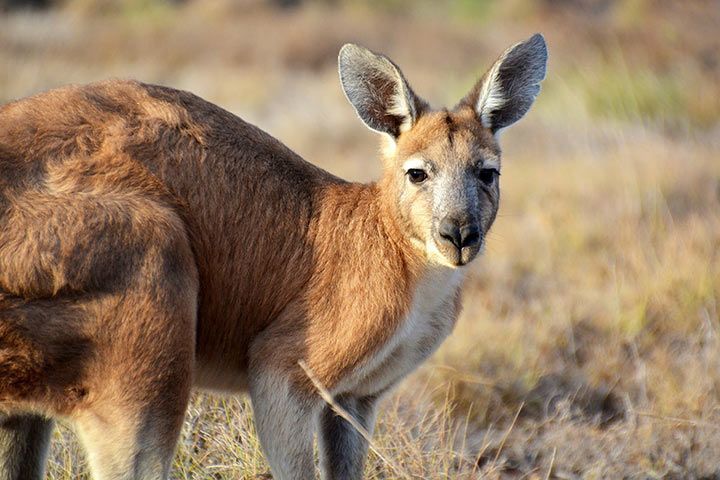
The red kangaroo is the largest kangaroo and also the biggest marsupial. Its most striking feature is its reddish-brown fur, which is only found in males. Female kangaroos, on the other hand, have a more purple-brown coloration. Another unique aspect is the white spots on their cheeks and the white stripe that runs from the corner of the mouth to the ear.

Species

There are about 65 species of kangaroos. These include hare kangaroos, tree kangaroos, rock kangaroos, wallabies, and giant kangaroos. The adorable quokka is also a type of kangaroo.


ADVERTISEMENT - ARTICLE CONTINUES BELOW

Red Kangaroo Mother With Joey Red Kangaroo Mother With Joey - Photo: Benny Marty/Shutterstock

Distribution and Habitat

Red kangaroos inhabit Australia, residing in open, dry to semi-arid areas such as semi-deserts, steppes, and bushland. During the day, they seek out shade from trees or bushes. They are extremely well adapted to the heat.

Way of Life

Red kangaroos are active during the night and twilight. They spend the day – which is the hottest part of the day – sleeping and resting. They form small groups made up of their closest family members. Often, they are also solitary.

Adaptations to the Habitat

104 degrees Fahrenheit (40 degrees Celsius) is not uncommon in the steppes and bushland of Australia. How do kangaroos survive this heat? On their arms, they possess thin skin with numerous blood vessels underneath. They lick their arms and let the wind blow over them – this way, the blood cools down. The hair in their dense fur is very thin and short. When it's cold, it helps retain body heat, and when it's hot, it aids in releasing body heat – especially when the wind blows. Additionally, the red kangaroo is most active at night when it’s cooler.

  • Cooling down by licking the arms
  • Fur reflects sunlight
  • Short and thin hair
  • Active at night

Red Kangaroo Characteristics Red Kangaroo Characteristics - Photo: Alex Godoy Photography/Shutterstock


ADVERTISEMENT - ARTICLE CONTINUES BELOW

Anatomy and Appearance

Size and Weight

The red kangaroo is the largest kangaroo and also the biggest living marsupial. It has a body length of 33-63 inches (85-160 cm) , with a tail length of 25-47 inches (65-120 cm), and weighs between 39-121 pounds (18-55 kg). Typically, they stand around 59 inches (150 cm) tall. In rare instances, males can reach up to 70 inches (180 cm) in height and weigh as much as 198 pounds (90 kg). Male kangaroos are twice the size and weight of females.

Pouch

Only female kangaroos have a pouch. They raise their young in it.

Tail

For the red kangaroo, its tail acts like a fifth leg. It can use it to support itself anywhere. With strong muscles in its tail, it can also push off effectively with it.

Red Kangaroo or Grey Kangaroo – What's the Difference? Red Kangaroo or Grey Kangaroo – What's the Difference? - Photo: Jason Benz Bennee (left), Robyn Butler (right)/Shutterstock


ADVERTISEMENT - ARTICLE CONTINUES BELOW

Red or Grey Kangaroo – What's the Difference?

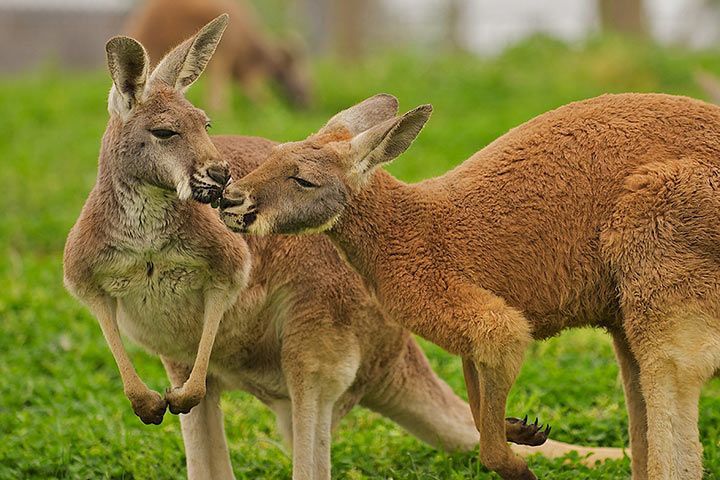
The difference seems clear: one is red and the other is grey. However, it’s not that simple. In the case of the red kangaroo, only the males have a red coat. The females tend to have a more purple hue. The grey kangaroo, on the other hand, has grey fur that is rough and coarse. In contrast, the red kangaroo has a very velvety and soft coat. The facial features also vary significantly. Red kangaroos possess much larger eyes and a broader nose. They have white spots on their cheeks and white stripes that extend from the corner of their mouths to their ears. The grey kangaroo, in comparison, has a uniformly grey face.

Diet

Red kangaroos are herbivores. They primarily feed on grass. Additionally, they consume leaves and tree bark.

Behavior

Defense

Red kangaroos defend themselves against dingoes by leaning on their tails and delivering powerful kicks with their legs. Additionally, they use their fists to fight back.

Fights Among Peers

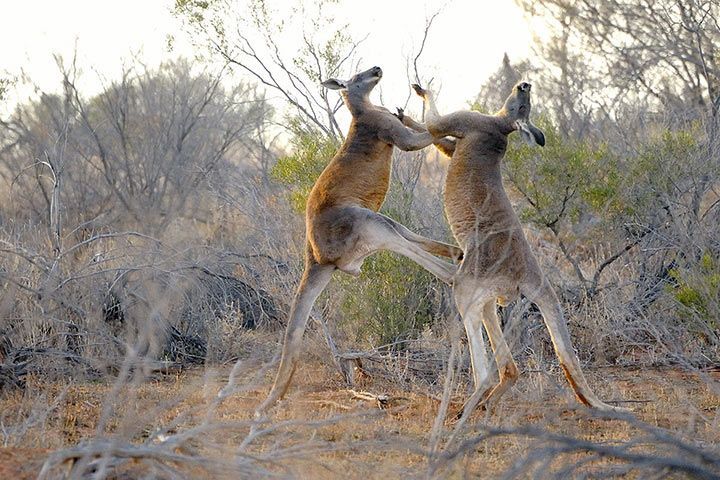
During mating season, it's common to see two male kangaroos battling it out. They don't hold back in their confrontations. They use their fists to box and their legs to deliver powerful kicks. However, these fights usually end without any bloodshed. The main goal is to intimidate the rival.

Red Kangaroo Red Kangaroos - Photo: John Carnemolla/Shutterstock

Senses and Abilities

Hopping

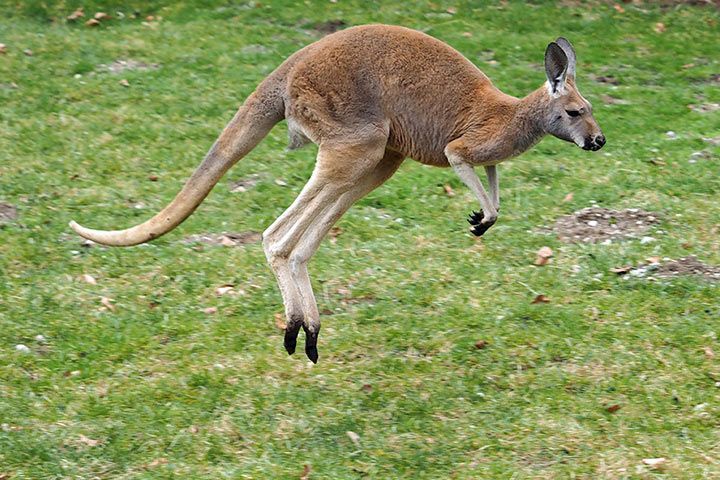
The faster a kangaroo hops, the less energy it uses. This is due to an elastic band in its hind legs. When it lands on the ground, the band stretches, snaps back, and propels it upward – much like a spring. They don't place their feet down one after the other; instead, they always hop with both legs at the same time.

Jumping

How far can kangaroos jump? Red kangaroos can leap 26-29 feet (8-9 meters) in a single bound and reach heights of 6.5-10 feet (2-3 meters). The grey kangaroo can jump even further, achieving a distance of 44.5 feet (13.5 meters), making it the second largest after the red kangaroo.

Moving Backwards

Kangaroos are unable to move backwards. This is due to the unique shape of their feet. Additionally, their tail would get in the way. They can't run anyway. They can only hop!

Swimming

Kangaroos are unable to swim.

Kick Force

Red kangaroos possess strong muscles in their tails and legs. They have a kicking force of 759 PSI (pounds per square inch) and can kick with six times the strength of a human. This power is essential for defending themselves against predators or competing with other kangaroos in fights.

Bite Force

One would typically expect a strong bite force from predators, yet the red kangaroo can also deliver a powerful bite. Its bite force measures at 975 PSI, making it six times stronger than that of a human. For comparison, humans have a bite force of approximately 162 PSI.

Are Kangaroos Dangerous?

Red kangaroos are not dangerous to us humans. However, as always, the situation changes if we humans threaten or corner an animal. The red kangaroo possesses significant strength in its legs and defends itself by kicking. If a confrontation occurs because it feels threatened, a person can be seriously injured. Additionally, it can also deliver a strong bite.

Red Kangaroo Hopping Red Kangaroo Hopping - Photo: Benny Marty/Shutterstock

Life Expectancy

In the wild, Red Giant Kangaroos can live for about 8 to 10 years.

Enemies and Threats

Natural Enemies

The main natural predators of the red kangaroos are dingoes. In just one week, five dingoes can take down over 80 kangaroos. Birds of prey, foxes, and domestic cats pose a threat to the young ones. Additionally, extreme heat and drought contribute to the death of many young kangaroos. Most of them do not even reach the age of three due to the harsh living conditions. During particularly dry seasons, up to 83% of the young can perish.

Human Impact

Kangaroos – a Nuisance?

Kangaroos are often labeled as pests or even a plague. It is claimed that they reproduce excessively and ruin the landscape. However, these statements are not entirely accurate. They originate from the meat and leather industries, which seek to justify the killing and processing of kangaroos. In Australia, kangaroos have always existed, and a sudden, massive increase in their population is simply not feasible due to the harsh living conditions.

Road Traffic

According to Suncorp, one of the largest insurance companies in Australia, around 80% of the approximately 20,000 annual car accidents involving wildlife are attributed to kangaroos. This is easily explained: Australia has very few large mammals that are allowed to roam freely. As a result, kangaroos make up a significant portion of these incidents. Smaller mammals cause little to no damage, leading to fewer insurance claims. Often, the high accident statistics can be blamed on the drivers themselves, with 40% ignoring warning signs.

Conservation Status

Red kangaroos are not an endangered species. However, many other species are considered endangered or even critically endangered, such as rock kangaroos, tree kangaroos, and bush kangaroos.

Importance for the Ecosystem

Kangaroos play a crucial role in nature as a keystone species. They primarily feed on grass. By doing so, they help maintain the balance of the plant world, allowing various other animal species to find their habitat.

Red Kangaroo Joey Red Kangaroo Joey - Photo: K.A.Willis/Shutterstock

Reproduction

Mating Season

During the mating season, male animals turn their fur red to attract females. Fortunately, they don't need to head to the supermarket for hair dye. Their skin releases a red powder. The males compete for the females, exchanging punches and delivering strong kicks with their legs.

Delayed Development

During dry periods, the female can delay or even halt the development of her baby. This occurs for its own benefit, as it would otherwise perish. Once it rains again and grass begins to grow, development resumes. This strategy is often the only way for the baby to survive. Of course, this can only happen at a very early stage, when the baby is still an embryo.

Gestation and Birth

After mating, it takes 33 days for the baby to be born. At birth, it measures only about one inch (2.5 cm) in length and weighs nearly 0.02 ounces (0.8 grams). So, it is smaller and lighter than a cherry. It is born naked, blind, and completely helpless. Therefore, it immediately crawls into its mother's pouch after birth. There, it drinks from a teat of mother's milk and grows. After about 190 days, it leaves the pouch for the first time. By 18 months, it reaches adulthood.

Red Kangaroos Red Kangaroos - Photo: dmvphotos/Shutterstock

Name

How did the kangaroo get its name? There's a truly fascinating story behind it: In 1770, the British explorer James Cook was wandering around Australia when he spotted a kangaroo and asked in English, "What kind of animal is that?". James Cook received the reply: "Kangaroo". He mistakenly thought that was the name of the animal. However, what the Aborigines actually said in their language was: "I don't understand". This tale is still often recounted in the same way today. But: "Gangurru" (in the original language) actually refers to the kangaroo. So, it's just a humorous story that isn't true.

Fun Facts

Kangaroos Smell like Mice, Coffee, and Curry

Red kangaroos have a scent similar to mice. Eastern grey kangaroos smell like coffee beans, while western grey kangaroos have the aroma of curry spice.

The Red Kangaroo Is Related To:

Animals in the Same Biome:


Sources:

Recommended Videos:


Marsupial Species Fact Sheets


ADVERTISEMENT


See all topics on animalfunfacts.net: