

Budgie
Budgie Facts
| Size | 6-8 in (15-20 cm) |
| Speed | Unknown |
| Weight | 1-1.4 oz (30-40 g) |
| Lifespan | 5-10 years |
| Food | Seeds |
| Predators | Snakes, big birds |
| Habitat | Australia (worldwirde as a pet) |
| Order | Parrots |
| Family | Psittaculidae |
| Scientific name | Melopsittacus undulatus |
| Characteristics | Colorful plumage, typical warbling |
Main Characteristics
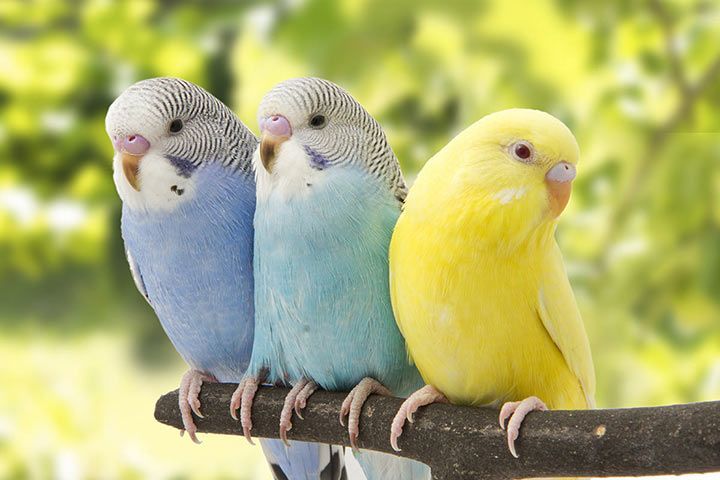
Budgies are among the most popular birds in the world and probably also the bird species most widely kept as a pet bird.
Distribution and Habitat
In the wild, budgies live together in large swarms in bushy areas and savannahs. They prefer eucalyptus trees.
Anatomy and Appearance
Colors
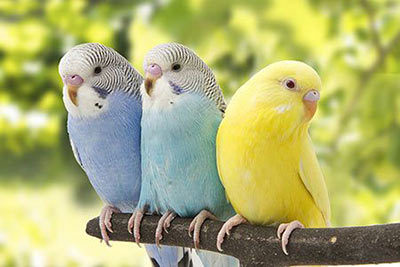
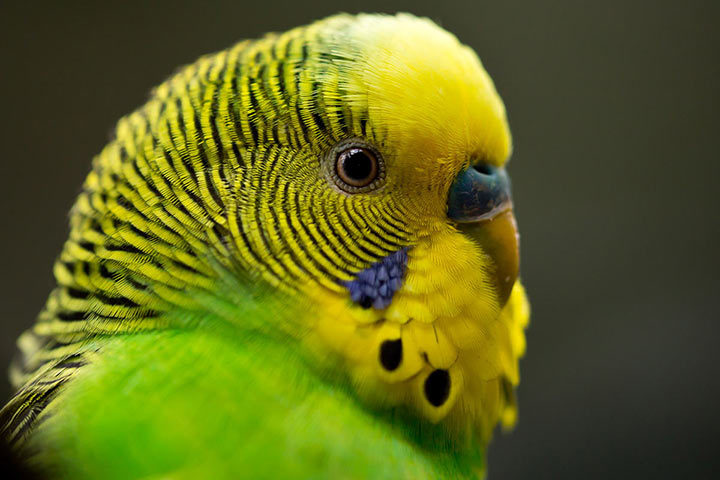
Their plumage shows transverse black markings, which are rather delicate on the head and back and are becoming increasingly wider towards the wings. They're green by nature, but today there are the most diverse color variants from yellow, yellow/green to white and blue.
Head
Budgies can rotate their head by 180 degrees. This helps them in the wild to look in all directions in order to detect birds of prey early enough. You can watch them rotate their head by 180 degrees when they're going to sleep. They puff themselves up und then turn their head to hide it under one of their wings. By the way: They have an upper, a lower, and an inner lid to protect the bird’s eye.
Evolution and Origin
Where Does the Name Come From?
The name budgeriar most likely derives from the language from the native australians. Budgeri means “good” and “gar” means cockatoo. You want to keep these birds? Our pet section has a detailed pet profile for the budgie and many other birds.
Senses and Abilities
Can Budgies Be Taught to Talk?
Budgies can utter eleven different sounds and are known for their typical warbling sound. Above all, they're very skilled talkers.
A budgie named Puck holds the record for being the bird with the largest vocabulary in the world. Puck was able to use 1,728 words. Unfortunately, the bird, which was owned by Camille Jordan, died in 1994. In 1995, Puck earned an entry in the Guinness Book of World Records with its amazing capabilities.
Sparkie Williams lived from 1954 to 1962 and was a talking budgie with a special talent: It knew eight nursery rhymes and 380 sentences by heart and could say more than 500 words. During a competition organized by the British broadcasting service BBC, Sparkie beat 2,768 other talking budgies and became a kind of celebrity in Britain. An album featuring Sparkie’s voice was recorded and sold 20,000 times. The budgie also inspired the British composer Michael Nyman and the German musician Carsten Nicolai to write an opera. It is called “Sparkie: Cage and Beyond” and was performed first in Berlin in March 2009.
Perception
Budgies Percieve Up to 150 Frames Per Second
A budgie can perceive up to 150 images per second. This is why they have problems with normal household lamps. For them, the lamps are permanently flickering.
In fact, this hasn't anything to do with the lamps, but with the electricity from the socket. It is an alternating current at a frequency of 50 Hertz. The human eye is too sluggish to discern the flickering and this is why we see a constant light. But for a budgie it is flickering. To relax their little eyes, most bird owners use a special electronic control gear that increases the Hertz value.
By the way: Humans can see about 16 images per second. If a movie ran at eight frames per second, we could perceive the images one by one.
Behavior
Flying Distance
Budgies can't build up fat reserves. They're quickly exhausted and therefore unable to fly long distances. They literally lack the “power” other birds draw from their fat resources. As a maximum, they can cover a distance of up to 62 miles (100 km) in a nonstop 3-hour flight.
Enemies and Threats
In the house: The cat ;) Out there in the wild, mainly birds of prey uch as hawks, sparrowhawks and falcons love budgies to bits.
Reproduction
Normally, they lay about four to six eggs, which are incubated by the female birds. The young birds hatch after about 18 days and do not weigh more than 0.07 ounces (2 grams). After 30–35 days they are already able to fly.
Girl or Boy?
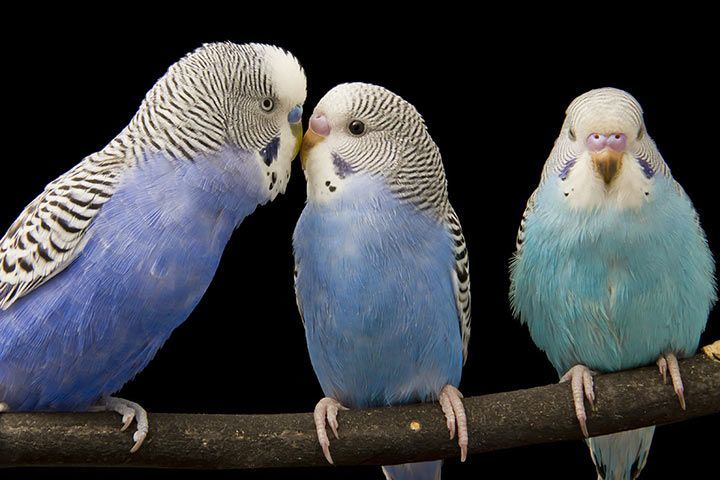
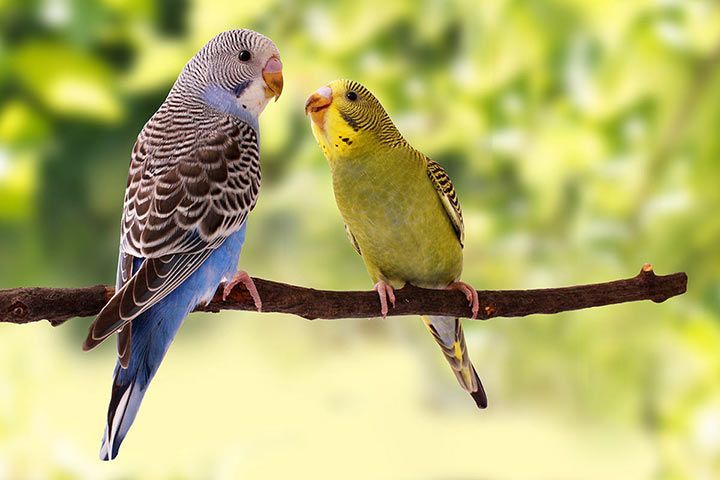
It is very easy to determine the gender of a budgie. Many have a blue or reddish-brown to white waxlike skin called “cere” (featherless area around the nose, above the beak). Males have a blue cere, females a reddish-brown to white cere. Chicks normally have a pink cere.
Life Expectancy
It is assumed that budgies can get 15 to 17 years old. Their normal life expectancy is five to ten years.
The Oldest
A Budgie named Charlie was born in April 1948 and did not stop warbling before June 1977 – at the age of 29 years and two months! This record has also been entered into the Guinness Book of World Records in 1995. Thus, Charlie officially is the world’s oldest budgie.
Fun Facts
Hansi-Bubi
“Hansi-Bubi” is not the average name of a budgie but indicates a breed of small budgies that come closest to the wild budgerigar.
Be Careful With These Foods!
Some foods and liquids are like poison for budgies: Avocado, chocolate, coffee, coffein, onions as well as products containing lactose.