animalfunfacts.net - The Animal Encyclopedia for Kids

ADVERTISEMENT

Echidna

Echidna Photo: Kristian Bell/Shutterstock

Echidna Facts

Size 14-30 inches (35-78 cm)
Speed 0.6-1.2 mph (1-2 km/h)
Weight 5.5-36 pounds (2,5-16,5 kg)
Lifespan 14-16 years (in the wild)
Food Ants, termites, insects
Predators Dingoes, foxes, dogs, cats
Distribution Australia, New Guinea, Tasmania
Habitat Bushland, desert, savannah, rainforest, forest, mountains
Order Monotremes
Family Tachyglossidae
Scientific name Tachyglossidae
Characteristics Spiny mammal with a long nose that lays eggs

Main Characteristics

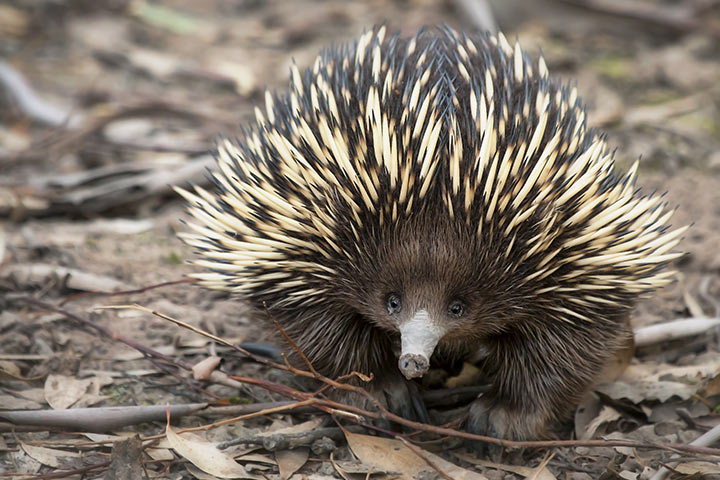
Echidnas look like small porcupines, hedgehogs or anteaters. In fact, they are often called spiny anteaters because of their diet. However, they are not related to them. They belong to a group known as monotremes. These are mammals that do not give birth to live young but instead lay eggs. There are only two species that do this: the echidna and the platypus. Notable features include their many spines and long snout.

Echidna Photo: Natalia Golovina/Shutterstock


ADVERTISEMENT - ARTICLE CONTINUES BELOW

Pronunciation

The echidna is pronounced as 'ih-kid-na'.

Species

There is one short-beaked echidna and three long-beaked echidnas: the Western and Eastern long-beaked echidna, and Sir David's long-beaked echidna. Their closest relatives are the platypuses.

Distribution and Habitat

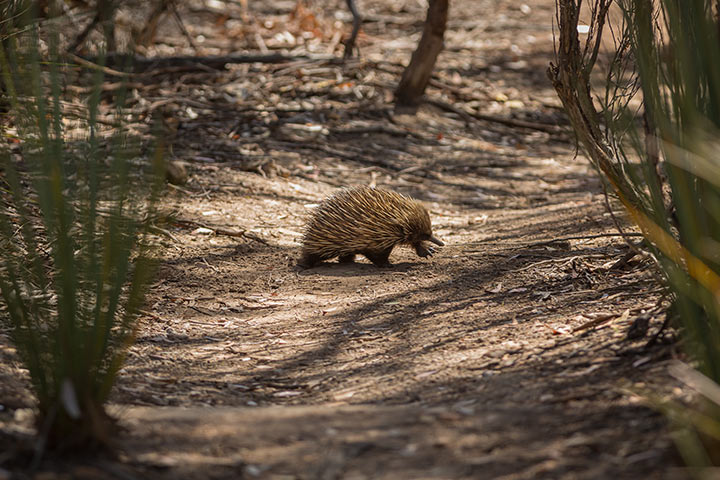
Echidnas can be found in Australia, Tasmania, and New Guinea. They are highly adaptable and thrive in a variety of habitats. They inhabit bushland, arid deserts, savannas, lush rainforests, and snowy mountainous areas. They require soil to dig in and can manage with both loose and compacted ground.

Way of Life

Echidnas are solitary creatures. They are active during the day and at dusk, sleeping at night. When they're not foraging in the ground for food, they take time to relax. Most of their time is spent searching for ants and termites, rummaging through leaves, digging in the soil, or breaking apart decayed wood with their claws. When they want to sleep or rest, they often hide under plants and roots or find shelter in tree hollows and rock crevices.

Echidna Characteristics Echidna Characteristics - Photo: Vicki Cain/Shutterstock


ADVERTISEMENT - ARTICLE CONTINUES BELOW

Anatomy and Appearance

Size and Weight

The short-beaked echidna is the smallest, measuring 14-20 inches (35-53 cm) in length and weighing 5.5-15 pounds (2.5-7 kg). In contrast, the western long-beaked echidna is the largest, reaching lengths of up to 30 inches (78 cm) and weights of up to 36 pounds (16.5 kg).

Appearance

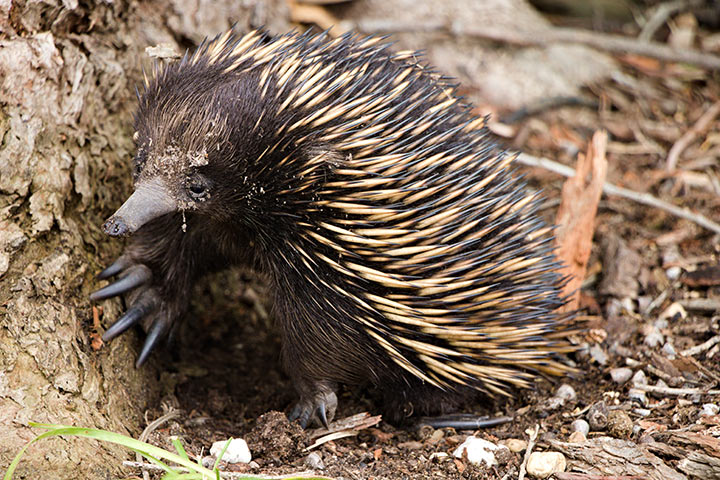
Echidnas have tiny eyes, a long snout, a sticky tongue, a rounded body, numerous spines, short legs, and strong claws.

Spines

The spines of echidnas are hollow on the inside, lack barbs, and can grow up to 2.3 inches (6 cm) long. They are made from the same material as our fingernails and are dark brown with a light brown tip. These spines are used for defense against wild dogs, foxes, and dingoes.

Fur

At first glance, it may seem like the echidna is just covered in spines, but it actually has fur too! This fur is quite dark, short, and hidden beneath its spiky exterior.


ADVERTISEMENT - ARTICLE CONTINUES BELOW

Snout

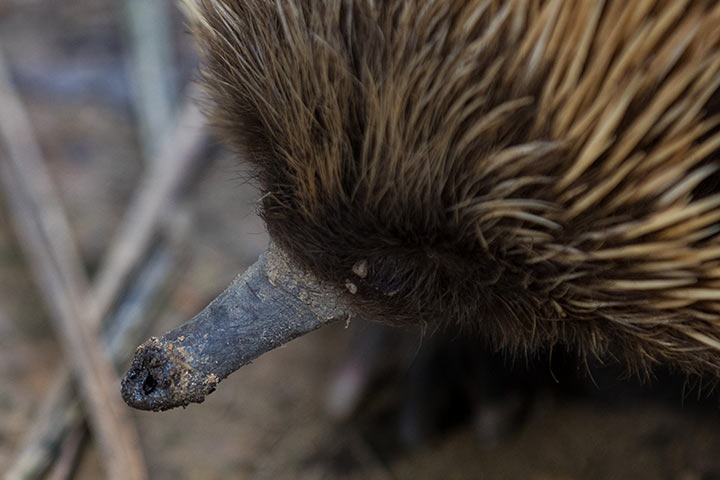
Echidnas have a long, slender snout that they use to probe and dig in the ground for their prey. The snout is also called a beak.

Tongue

Ant-eaters possess a long, sticky tongue covered in tiny spines, measuring 6-7 inches (15-18 cm) in length.

Teeth

Echidnas don't have teeth. They use their tongues to gather food, grind it with the horn plates in their mouths, and then swallow it.

Claws

Echidnas have strong claws on their hands and feet. They possess a particularly long claw on their feet, which they use to 'comb' through their spiky coat. This helps them remove dirt and parasites.

Ears

The ears of the echidnas are barely noticeable from the outside. They appear as subtle, narrow slits. However, they have an excellent sense of hearing.

Body Temperature

Echidnas have a very low body temperature of 86-89.6 degrees Fahrenheit (30-32 degrees Celsius). In comparison, humans have an average body temperature of about 96.8-98.6 degrees Fahrenheit (36-37 degrees Celsius).

Brain

Echidnas possess an unusually large brain, with the cerebral cortex accounting for 43% of its size, which is responsible for higher cognitive functions. In humans, this percentage ranges from 75% to 84%.

Spurs

Male echidnas have spurs on their hind feet, but unlike the platypus, they are not venomous.

Echidna or Hedgehog – What's the Difference? Echidna or Hedgehog – What's the Difference? - Photo: Chris Watson (left), Mirko Graul (right)/Shutterstock

Echidna or Hedgehog – What's the Difference?

Echidnas and hedgehogs have a distinctive spiny coat and curl up when threatened. However, hedgehogs belong to a completely different family: the insectivora. They are not related. Additionally, they inhabit different regions, specifically Europe, Africa, and Asia. There are also clear physical differences: hedgehogs are noticeably smaller and lighter, with shorter spines and claws, as well as a broader snout.

Echidna or Porcupine – What's the Difference? Echidna or Porcupine – What's the Difference? - Photo: wrightouthere (left)/stock.adobe.com, Silke (right)/tierchenwelt.de

Echidna or Porcupine – What's the Difference?

At first glance, echidnas and porcupines may look very similar, but distinguishing them is quite simple: porcupines are rodents. They are noticeably larger and heavier, with a much shorter and broader snout. Unlike their counterparts, they do not inhabit Australia, Tasmania, or New Guinea, but rather reside in Asia, Europe, Africa, and America. Additionally, they are nocturnal and enjoy living in social groups. Their quills have barbs. Ouch!

Diet

Echidnas are carnivores. They primarily feed on insects. Long-beaked echidnas prefer worms and larvae, while short-beaked echidnas favor ants and termites. They dig their snouts into the ground and rapidly flick their tongues to catch their prey.

While Foraging for Food, the Echidna Digs Into the Ground in Search of Insects While Foraging for Food, the Echidna Digs Into the Ground in Search of Insects - Photo: xSquared/Shutterstock

Behavior

Defense

What do echidnas do when they sense danger? If they need to find safety, they quickly dig a hole and curl up inside it. They have strong arms and can dig very quickly with their large, shovel-like claws. Within seconds, only their spiky back is visible—making it hard for predators to reach them! If digging isn't an option, they curl up into a ball or try to run away.

Are Echidnas Dangerous?

Echidnas are not aggressive or venomous. In fact, they are quite peaceful creatures. However, it's best to avoid handling them with bare hands, as their spines can cause injuries. Additionally, they may transmit diseases upon contact.

A Hedgehog Has Curled up to Protect Itself From Attacks A Hedgehog Has Curled up to Protect Itself From Attacks - Photo: Natalia Golovina/Shutterstock

Senses and Abilities

Senses

Echidnas have very small eyes and do not have particularly good eyesight.

Sense of Hearing

Even without outer ears, these animals have an exceptional sense of hearing.

Sense of Smell

Echidnas have an excellent sense of smell.

Electrosensitivity

Echidnas possess an exceptionally sensitive nose equipped with 400 to 2,000 electroreceptors. These receptors are specialized cells, derived from the Latin word 'recipere,' meaning 'to receive'. They enable echidnas to detect electrical signals, such as the muscle movements of other animals. The platypus has a similar feature, with electroreceptors located in its bill.

Locomotion

They are quite good at climbing and swimming.

Swimming Echidna Swimming Echidna - Photo: Shuttergirl2013/Shutterstock

Enemies and Threats

Natural Enemies

Echidnas are hunted by feral dogs and cats, as well as dingoes and foxes. They also face challenges from parasites like tapeworms.

Human Impact

The main threats to echidnas are hunting, habitat loss, and road traffic.

Conservation Status

The short-beaked echidna is the only species that is not considered endangered, while all long-beaked echidnas are classified as 'vulnerable' or even 'critically endangered'.

Importance for the Ecosystem

It isn't always immediately clear why a particular animal is crucial for maintaining balance in nature, especially when it comes to a small and oddly shaped creature. However, researchers have discovered that echidnas dig up about 7.000 cubic feet (200 cubic meters) of soil each year in their quest for food. That's equivalent to over 1,300 bathtubs full of earth! As they dig, these animals aerate the soil and enrich it with nutrients.

Echidna Photo: Ivana Svecova/Shutterstock

Reproduction

Mating Season and Mating Ritual

The mating season for echidnas occurs from June to August. During this time, a unique ritual called the 'echidna train' takes place, where sometimes over 10 males follow a female in a line. This procession can last for days or even weeks until she finally chooses one of the males.

Hatching from an Egg

Female echidnas lay only one egg at a time. After laying, they keep it in a pouch on their belly, much like kangaroos do with their newborns. About 10 days later, the baby hatches. At this stage, it measures just 0.47-0.59 inches (12-15 mm) in size and weighs only 0.05-0.07 ounces (1.5-2 grams), roughly the size and weight of a grape. Newborn echidnas are called a puggle.

„Breast Milk“

The puggle is fed with breast milk, which is not released from the nipples like in other mammals, but rather 'sweated' out through many tiny pores. This is similar in the case of the platypus.

Raising the Puggle

After around 53 days, the puggle is big and strong enough to leave the pouch. For its safety, it stays in a small burrow that the mother has dug. She visits every 5-10 days to feed her young one. By about 7 months, the baby becomes independent.

Echidna Echidna - Photo: Wonderly Imaging/Shutterstock

Fun Facts

Largest Egg-Laying Mammal Ever

Hackett's giant echidna (Murrayglossus hacketti) was the largest egg-laying mammal on the planet, reaching lengths of up to 3 feet 3 inches (1 meter) and weighing 44-66 pounds (20-30 kg). It went extinct nearly 12,000 years ago.

Greek Mythology

In Greek mythology, there is a figure named Echidna. She is part woman and part snake, known as the mother of all monsters. She also appears in the series 'Percy Jackson.'

Sonic the Hedgehog

In the video game Sonic the Hedgehog, the blue hedgehog Sonic has a friend named Knuckles, who is a red echidna.

The Echidna Is Related To:

Animals in the Same Biome:


Sources:


Monotreme Species Fact Sheets


ADVERTISEMENT


See all topics on animalfunfacts.net: