Toucan
Toucan Facts
| Size | 13.7-25.5 inches (35-65 cm) |
| Speed | Up to 40 mph (64 km/h) |
| Weight | 0.3-1.4 pounds (130-680 grams) |
| Lifespan | 12–20 years |
| Food | Fruits, eggs, insects |
| Predators | Weasels, big birds |
| Distribution | Central and South America |
| Habitat | Tree canopies |
| Order | Piciformes |
| Family | Toucans |
| Scientific name | Ramphastidae |
| Characteristics | Large tropical bird with a huge, lightweight beak |
Main Characteristics
The toucan is one of the most fascinating and colorful birds in the rainforest. Its huge, vibrant beak makes it stand out immediately. It seems almost as large as the bird itself! Isn't the beak incredibly heavy? You'll find out more about that below! This bird is not only a sight to behold but also plays a crucial role in nature: it helps keep the forest healthy.
Species
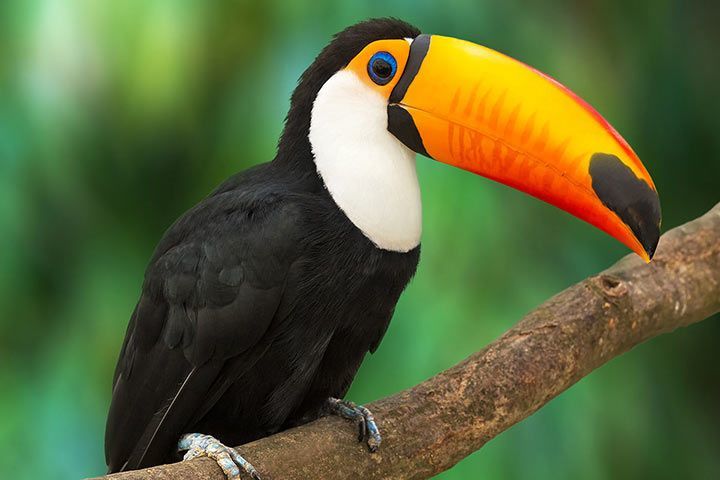
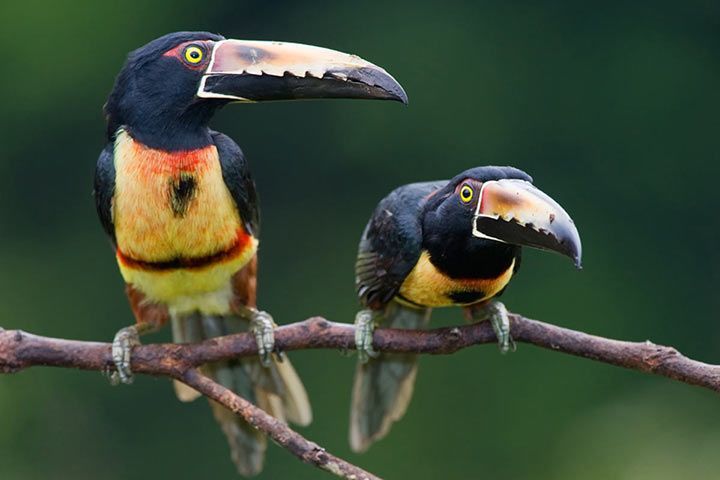
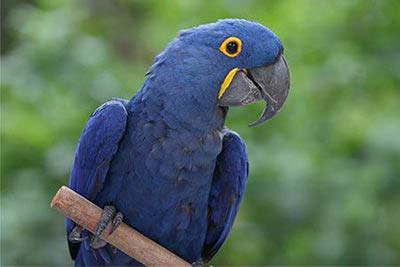
The toucan is often mistakenly referred to as a parrot due to its vibrant colors. However, that is not accurate! It actually belongs to the family of woodpeckers. There are approximately 45 species in total. The most well-known is the great toucan, which features a white "bib," black plumage, and a yellow beak. Toucans also include the aracaris, which are a smaller subspecies of toucans, known for being more social and typically living in larger groups.
Distribution and Habitat
Toucans inhabit the warm areas of Central and South America. Typically, they are rarely seen in the dense jungle. They prefer to stay high up in the treetops. There, they look for old, natural tree cavities to nest in. It's a pity, considering their vibrant plumage – who wouldn't want to admire them up close?!
Lifestyle
Toucans are diurnal. They live in small family units or groups of 6-12 birds. Together, they forage for food and alert each other to potential threats. Even when it comes to sleeping, they often share a single tree cavity with several individuals.
Anatomy and Appearance
Size and Weight
The toucan varies in size depending on the species, reaching a body length of 13.7-25.5 inches (35-65 cm) and weighing 0.3-1.4 pounds (130-680 grams).
Their Tongue Resembles a Feather
The toucan possesses a highly unique tongue: it is long, extremely narrow, and features delicate fringes along the sides. This gives it an appearance similar to that of a real bird feather. This distinctive shape aids the toucan in skillfully maneuvering food within its large beak and effectively transporting bite-sized fruit pieces down its throat.
Their Feet Have a "Climbing System"
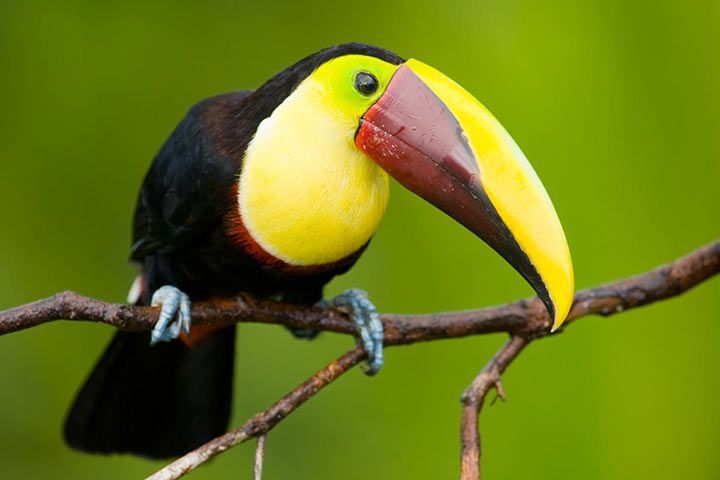
Toucans have what are known as zygodactyl feet. In simple terms, this means that two toes point forward and two toes point backward (like an X). Most birds we are familiar with have three toes facing forward and one backward. This toucan foot structure acts like a built-in climbing grip, providing them with exceptional stability while balancing on thin branches in the wind.
The Beak: The Built-in Tool
Extra Large, Yet Incredibly Light!
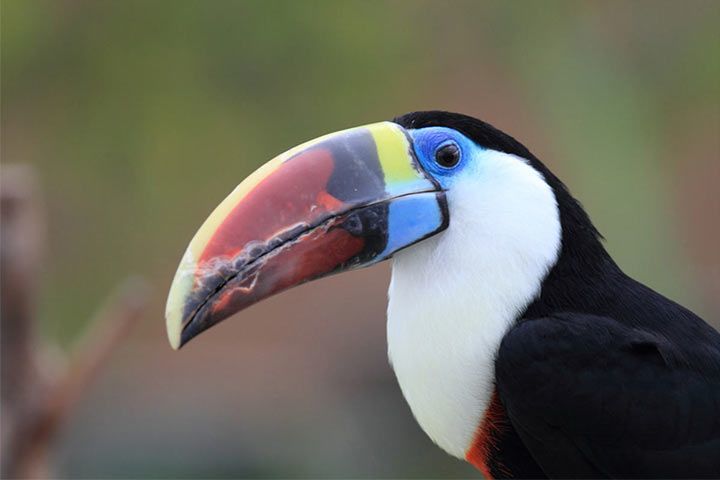
The toucan's beak is enormous. It can be up to four times larger than its entire head and can measure up to up to 8 inches (20 cm) in length. Despite appearing heavy and cumbersome, the beak is actually very lightweight. This is because it is not made of solid bone on the inside, but rather is hollow and structured like a solid sponge. It only weighs 1-1.4 ounces (30-40 grams).
What Does it Need its Large Beak For?
• Lowering Body Temperature
Researchers have discovered that the beak functions as a built-in air conditioning system. When it gets hot, the toucan directs warm blood into its beak. The beak releases heat into the air, helping the bird cool down – much like an elephant uses its large ears!
• Picking Fruits
Additionally, the beak assists the toucan in reaching fruits on thin branches that would be too weak for other animals.
• Sparring with Peers
Toucans exhibit fascinating social behavior, which scientists refer to as “bill fencing”. In this playful interaction, the birds “strike” their large beaks against each other like fencing swords, either in play or to establish social hierarchy. What may seem wild is often just a harmless game among friends.
Diet
Toucans are omnivores. They consume 80% fruit, but they are also skilled opportunistic hunters! When the opportunity arises, they raid the nests of other birds. With their long beaks, they fish out eggs and even newly hatched chicks. Occasionally, their diet includes large insects, small lizards, or tree frogs.
Behavior
How Do Toucans Ssleep?
To save space in their snug tree cavities, toucans have a clever trick: When they sleep, they lay their long beak flat against their back. They then fold their tail over their head. When curled up this way, they resemble a small, round ball of feathers.
Abilities and Senses
Are Toucans Good Flyers?
Toucans are true forest dwellers. They mostly stay high up in the treetops. Toucans are not particularly good at flying. Therefore, they usually hop from branch to branch. When they do take to the air, their flight appears wavy: a few quick flaps followed by a brief glide.
What Do Toucans Sound Like?
Toucans are quite noisy. Their calls do not resemble the songs of other birds at all. They croak more like frogs or bark like small dogs. In the dense jungle, their calls can be heard over 500 meters away.
Life Expectancy
In the wild, toucans can live between 12 to 20 years.
Enemies and Threats
Natural Enemies
In the forest, toucans must be cautious of large birds of prey like eagles. While nesting in their tree cavities, they are also at risk from snakes, monkeys, or weasels that may steal their eggs and defenseless chicks.
Human Impact
• Habitat Loss
Toucans require very old, large trees for living and breeding. They are finding it increasingly difficult to locate a home as more rainforests are being cleared—primarily for growing animal feed (which is even transported to Germany) or for livestock farming.
• Pet Trade
Due to their vibrant colors, toucans are often illegally captured and sold as pets.
Importance for the Ecosystem
Toucans often swallow fruits whole and later excrete the seeds elsewhere unharmed, effectively planting the forest of tomorrow. This is why they are referred to as the "gardeners of the rainforest".
Reproduction
Faithful for Life
Toucans are monogamous. They choose a lifelong partner and stay together.
The Nest
They cannot carve out nesting cavities in wood themselves. Therefore, they look for natural holes in old trees or utilize abandoned woodpecker holes.
The Eggs
The female lays 2-4 white eggs. Both parents take turns incubating them. After about 16-18 days, the chicks hatch.
The Chicks
The hatchlings are born naked and blind. They remain in the nest for a considerable time – around 40-60 days – until they can fly. It takes them about 3-4 years to reach maturity and be able to have their own young.
Fun Facts
Superstition
In some ancient tales of the indigenous people of South America, it was said that the Toucan possesses magical powers or spirits. In the past, new fathers in certain tribes were forbidden from eating Toucan meat. They feared that doing so would put a curse on their baby. Some shamans used the Toucan in their rituals as a protective animal.
The Toucan Is Related to:
- African Barbets
- Asian Barbets
- New World Barbets
- Toucan-Barbets
Animals in the Same Biome:
- Coati
- Flying Snakes
- Harpy Eagle
- Hyazinth Macaw
- Ocelot
- Poison Dart Frog
- Sloth
Sources:
- Heat exchange from the toucan bill reveals a controllable vascular thermal radiator (https://pubmed.ncbi.nlm.nih.gov)
- Energetic costs of bill heat exchange demonstrate contributions to thermoregulation at high temperatures in toco toucans (Ramphastos toco) (https://pubmed.ncbi.nlm.nih.gov)
- Successful frugivory interactions recovery 53 years after the reintroduction of the ariel toucan Ramphastos ariel in the Atlantic forest (https://nsojournals.onlinelibrary.wiley.com)
Recommended Videos:


Rainforest Animals