Peregrine Falcon
Peregrine Falcon Facts
| Size | 13.7-20 inches (35-51 cm) |
| Speed | Up to 200 mph (322 km/h) (stoop) |
| Weight | 1.2-2.9 pounds (0.55-1.3 kg) |
| Lifespan | 15-18 years |
| Food | Birds |
| Predators | Predators, other birds of prey |
| Habitat | Worldwide |
| Order | Falconiformes |
| Family | Falconiformes |
| Scientific name | Falco peregrinus |
| Characteristics | Fastest bird in the world; barring on the chest |
Main Characteristics
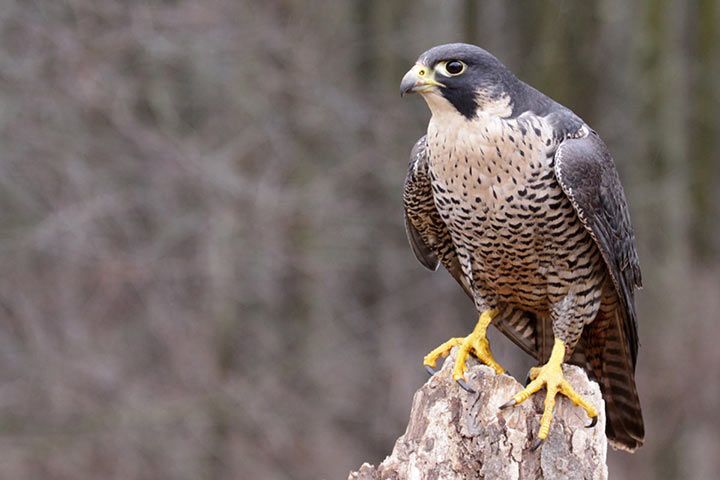
The peregrine falcon is the fastest animal in the world. In a dive, it can reach speeds exceeding 300 km/h – which is why it is often referred to as the "cheetah of the skies". Its most distinctive features include the banding on its chest, the yellow base of its beak, and the yellow-ringed eyes. It is found almost worldwide and skillfully utilizes natural rock cliffs as well as tall buildings in modern cities as its habitat.
Distribution and Habitat
The peregrine falcon is a true globetrotter. No other bird of prey is as widely distributed as it is. You can find it on nearly every continent and in various habitats – from the icy tundra to deserts and mountains, all the way to coastlines. As an urban dweller, it has even conquered the city, successfully nesting in church towers, on skyscrapers, or on bridge pillars.
Related Species
Interestingly, peregrine falcons are not (!) closely related to eagles, buzzards, or hawks. Genetic studies reveal that they are more closely related to parrots and songbirds. Their resemblance to other birds of prey is due to a phenomenon known as "convergent evolution" (convergent = "matching"): As aerial hunters, they have developed similar physical traits. It's akin to a race car driver and a pilot both wearing helmets – just because they both wear helmets doesn’t mean they are brothers.
Lifestyle
Peregrine falcons are diurnal. They spend most of their time perched in a spot with a panoramic view (like cliff edges, treetops, or church steeples). From these vantage points, they launch their hunts. They are solitary and spend the majority of their lives alone, except during the breeding season.
Anatomy and Appearance
Size and Weight
Peregrine falcons reach a size of 35-51 cm and have a wingspan of 79-114 cm. Their weight ranges from 330-1,500 g. Interestingly, like most birds of prey, female peregrines are larger and heavier than their male counterparts.
Curved Beak
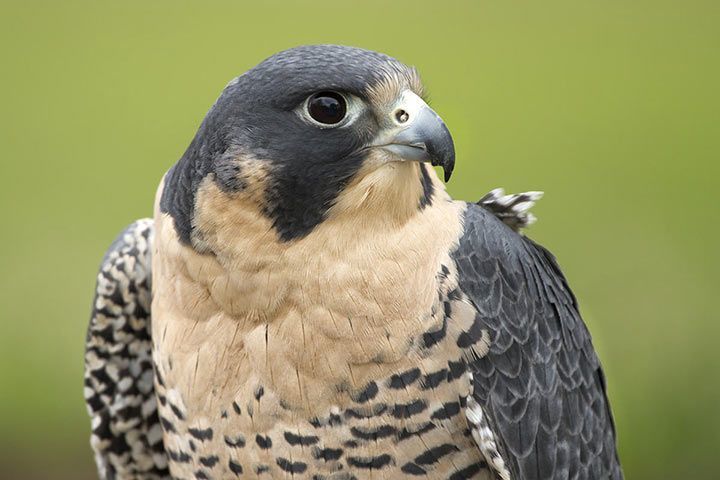
The tip of the upper beak is extremely sharp and curved downwards – similar to a scalpel, allowing for clean cuts of their prey.
The Falcon Tooth (Tomial Tooth)
The falcon tooth is not a real tooth made of bone like ours. It is a small, horn-like projection located just behind the beak's tip. It acts like a bone crusher, enabling the falcon to swiftly sever the spine of its prey with a precise bite.
Nasal Bosses (Tubercle)
The nasal bosses are tiny bony protrusions found in the center of the nostrils. They function like wind deflectors, redirecting the intense air pressure during a dive, allowing the peregrine to breathe easily without harming its lungs.
Adaptions
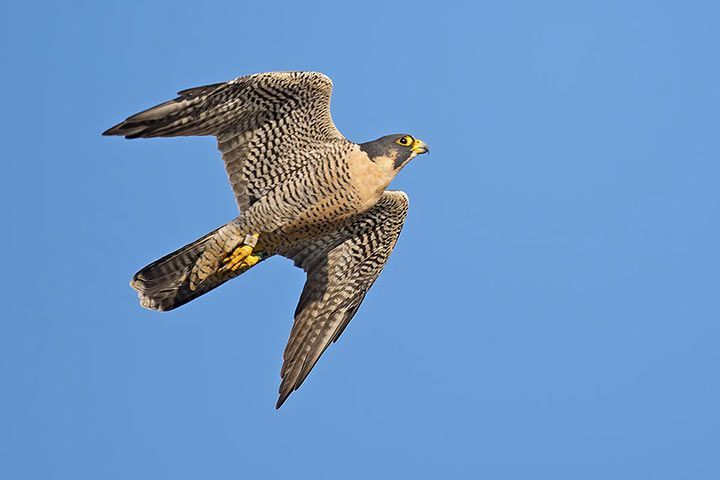
- Pointed, narrow wings: designed for quick directional changes
- Stiff feathers: durable at high speeds
- Strong pectoral muscles: for maximum acceleration
- Nasal tubercle: redirects airflow during a dive
- Falcon tooth (tomial tooth): aids in swiftly killing prey
- Large eyes: excellent vision for judging distances
- nictitating membrane: third eyelid that protects against wind, dust, and dehydration
- Facial stripe (malar stripe): dark plumage beneath the eyes; acts like sunglasses
- Chest banding – enhances camouflage against rocky surfaces
Diet
The peregrine falcon is a carnivore. It primarily feeds on other birds, especially doves, but also hunts shorebirds and songbirds. It only occasionally preys on rodents.
Behavior
Hunting Technique
The peregrine falcon is like a "stuntman of the skies." Here are its 6 "combat phases" that ensure success in every hunt:
- 1. Preparation is key: It looks for a high vantage point as a "launch pad" and keeps watch.
- 2. Attack from nowhere: It dives at speeds exceeding 300 km/h towards its prey (up to 322 km/h).
- 3. The karate kick: In mid-air, it delivers a kick with its talons to stun its prey – just like a martial arts fighter.
- 4. Aerial acrobatics: It snatches its prey in a flash, before it even touches the ground.
- 5. Falcon's bite: With a precise bite to the neck, it kills its prey.
- 6. Plucking: In a safe location (also known as "falcon plucking"), it removes the feathers before consuming its catch.
Senses and Abilities
Speed
In a dive, known as a "stoop", the peregrine falcon can reach speeds of up to 322 km/h.
Vision
The peregrine falcon possesses exceptional eyesight. It can spot prey from several kilometers away. However, to determine if it is a pigeon or another bird, it needs to get within 1-2 km. It is said that it can see three times sharper than humans.
Enemies and Threats
Natural Enemies
The greatest natural enemy of the peregrine falcon is the eagle owl. It hunts at night, catching the peregrine falcon off guard while it sleeps. The biggest threat to the young ones comes from clever nest robbers like martens, ravens, and crows.
Humans
Pesticides
In the mid-twentieth century, the peregrine falcon was on the brink of extinction. The culprit was the pesticide DDT. This poison caused the eggshells of peregrine falcons to become too thin, leading to the death of the chicks. Fortunately, the species was placed under strict protection. According to an estimate by the IUCN, there are now between 100,000 and 500,000 adult birds worldwide. As a result, it is no longer considered endangered.
Reproduction
Adventurous Courtship Flight
Males impress females with looping and diving flights. Additionally, they "present" prey as gifts to show their affection. He drops it mid-flight, and she catches it in the air as well.
Faithfulness to Habitat and Partner
Peregrine falcons often stay together for life and return to the same nesting site each year.
No Traditional Nest
Peregrine falcons do not create elaborate nests from twigs. Instead, they scrape a simple depression in the ground (gravel, rock, or masonry) where they lay their eggs.
Teamwork in Incubation
Once the female has laid 3-4 eggs, she stays in the nest to incubate them and protect them from predators. The male hunts for the female and brings her the prey he has caught.
Fluffy Cotton Balls
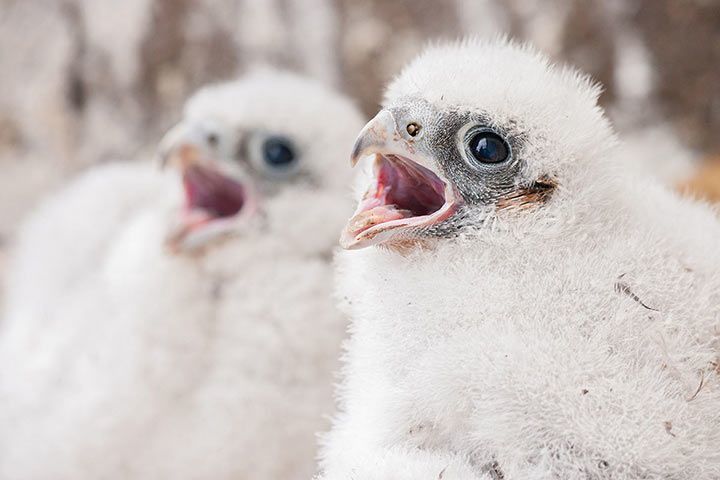
Chicks start off as tiny, fluffy "cotton balls". After 4-6 weeks, they develop their feathers and strengthen their flight muscles. After about 3 months, they become independent.
The Peregrine Falcon Is Related to:
- American Kestrel
- Amur Falcon
- Common Kestrel
- Gyrfalcon
Animals in the Same Biome:
- Bat
- Blackbird
- Dormouse
- Eurasian Eagle-Owl
- Green Woodpecker
- Ibex
- Jackdaw
- Kestrel
- Lapwing
- Laughing Gull
- Long-Eared Owl
- Mouse
- Pigeon
- Rat
- Raven
- Rock Dove
- Starling
- Swift
- Teal
- Thrush
- Wall Lizard
- Wood Pigeon
Sources:
- Whole-genome analyses resolve early branches in the tree of life of modern birds (https://pubmed.ncbi.nlm.nih.gov)
- Diving-Flight Aerodynamics of a Peregrine Falcon (Falco peregrinus) (https://pmc.ncbi.nlm.nih.gov)
- Physics-based simulations of aerial attacks by peregrine falcons reveal that stooping at high speed maximizes catch success against agile prey (https://journals.plos.org)
- Falcons pursue prey using visual motion cues: new perspectives from animal-borne cameras (https://pmc.ncbi.nlm.nih.gov)
- The Deep Fovea, Sideways Vision and Spiral Flight Paths in Raptors (https://www.researchgate.net)
- Breeding habitat selection of urban peregrine falcons (Falco peregrinus) in London (https://www.researchgate.net)